by reframe.food, UNIPI, alchemia-nova, Pongau MAP
How can rural areas transform local waste into technological innovation that strengthens social, economic, and environmental resilience?
This central question drove the recent capacity-building stakeholder workshop held on March 27, 2026, at the Haus der Region in Bischofshofen, Austria.
This FUTURAL event, organized by Pongau MAP and alchemia-nova partners, brought together regional experts and stakeholders to explore sustainable pathways for the circular bioeconomy, specifically focusing on the future of sewage sludge utilization in the Pongau region.
Expert Insights and Regulatory Frameworks
The workshop was guided by Antonia Zerobin and Max Läuger, Project Managers at alchemia-nova, in close collaboration with Josef Fanninger and Stephan Maurer from the Regionalverband Pongau – local organization leader of the Pongau MAP.
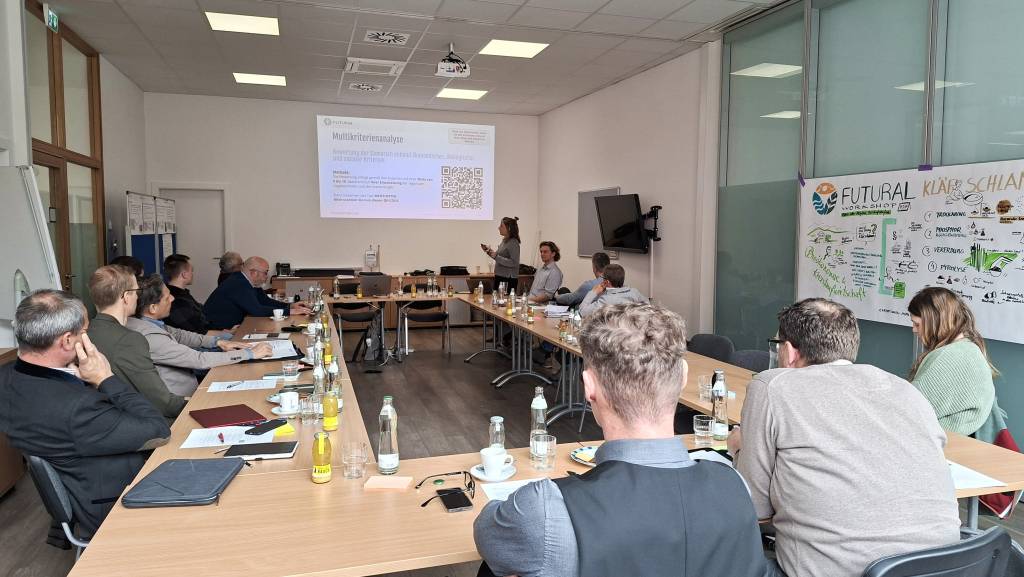
To set the stage, process engineering expert Harald Karl Winkler provided a deep dive into the complex legal and technical landscape. A key focus was the Austrian Waste Incineration Ordinance (AVV 2024), which mandates that from January 1, 2033, sewage sludge from plants with a capacity of 20,000 population equivalents (PE) or more must recover phosphorus either directly during the treatment process or from the ashes after incineration. In the Salzburg region, this law will impact 17 of the 29 existing plants.
Analyzing Local Scenarios
Building on these technical foundations, the workshop explored several technological “Smart Solution” scenarios specifically adapted for the RHV Salzburger Ennstal plant in Radstadt:
- Status Quo: Current truck-based transport for incineration and landfilling.
- Drying: Reducing transport volume significantly by utilizing waste heat
- Phosphorus Recovery: Reclaiming nutrients from ash to be reused as agricultural fertilizer.
- Humification (Vererdung): Utilizing reed beds for long-term stabilization.
- Pyrolysis: Producing “biochar” to fix carbon and retain minerals.
Participants were supported by illustrative Sankey diagrams derived from a previously conducted Material Flow Analysis (MFA), which visualized the energy and mass balances of each scenario.
Interactive Evaluation and “Smart Solution” Testing
The core of the workshop was the hands-on testing and the capacity-building process of the Circular Bioeconomy Platform, a digital tool developed by FUTURAL to support participative and holistic decision-making. Using a Multi-Criteria Decision Analysis (MCDA) approach, stakeholders evaluated the scenarios based on nine distinct criteria across economic, ecological, and social dimensions.
The real-time results, visualized directly through the online tool, showed that while the “Status Quo” currently works well, it scores poorly in long-term sustainability compared to the other innovative scenarios, which all l scored differently across the several criteria. By adjusting the weighting of perceived relative importance of the criteria, stakeholders could immediately see changes on the outcome and discuss courses for action for the regional valorization of sewage sludge.
Visualizing the Future
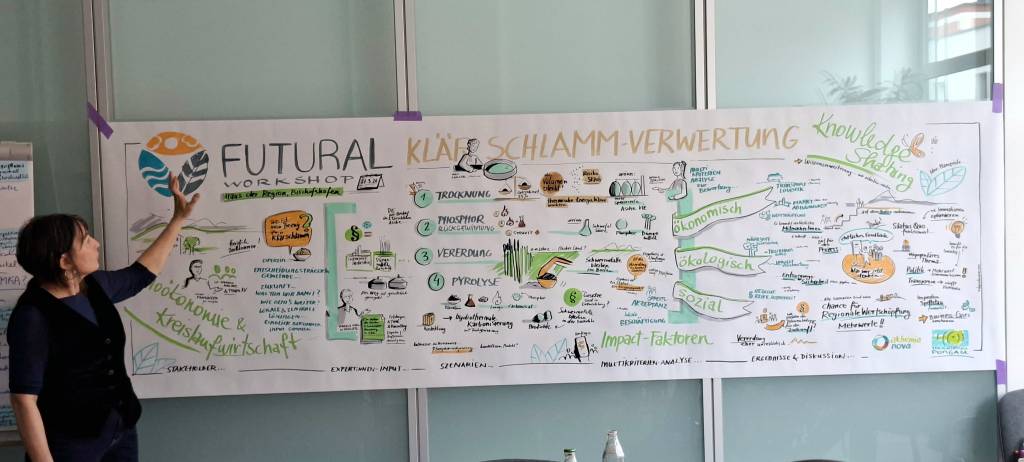
The entire dialogue was captured through live illustration by Daniela Waser (Graphic Recording), providing a creative and clear summary of the complex insights gained throughout the morning.
By turning EU Biodiversity and Bioeconomy strategies into practical, digital tools, the FUTURAL project is helping rural regions like Pongau become more self-sufficient and resilient.