By Miranda García Lera (AEIDL)
In May and June 2026, FUTURAL organised the second edition of the European Rural Innovation Forum (EU-RIF) through two connected events: an in-person forum in Jonava, Lithuania, followed by an online policy webinar.
The EU-RIF is a networking and knowledge-exchange opportunity that brings together rural ecosystem stakeholders, representatives of rural innovation networks, policymakers, practitioners, EU-funded research and innovation projects, organisations and entrepreneurs. It aims to strengthen participants’ capacity and support the exchange of expertise on smart, community-led innovation in rural areas.
This edition’s events explored how Smart Villages and community-led innovation can move from local experimentation to wider, long-term uptake across Europe.
As leader of FUTURAL’s policymaking and governance work and organiser of the EU-RIF, AEIDL helped connect practical experience from rural territories with wider EU policy debates. The Jonava EU-RIF gathered examples, challenges and lessons from practitioners and rural innovators, while the online webinar built on these findings to examine and validate the governance frameworks and enabling conditions needed to support the uptake, scaling and long-term sustainability of rural innovation in the post-2027 programming period.
Learning from rural innovation in practice
The Jonava EU-RIF, held on 5–6 May under the title “From Smart Villages to Smart Rural Futures: experiences from the Baltic region”, brought together 64 participants, with strong representation from the Baltic region (Lithuania, Latvia and Estonia) alongside several other European countries.
Co-organised by AEIDL, Jonava Municipality and project partners, the event combined policy dialogue, demonstrations of FUTURAL Smart Solutions and participatory workshops. Its main purpose was to explore what makes rural innovation work in practice and which conditions are needed to launch, co-create and sustain local innovation initiatives.
A central message was that rural innovation is not only about technology. Participants stressed that a territory becomes “smart” through the way people use local resources, cooperate, address shared challenges and adapt solutions to their own context. Innovation can therefore be digital, but also social, organisational, cultural or logistical.
Examples included multifunctional community centres, mobile public services, community transport, rural broadband, local food initiatives, cultural projects and digital tools supporting businesses and public services. These experiences showed that successful innovation usually combines local knowledge, community involvement, effective leadership and external support.
The discussions also highlighted that Smart Villages should build on the strengths and opportunities of a territory, rather than focusing only on its problems. Strong communities, active local leaders, territorial identity and cooperation between municipalities, businesses, associations and residents were repeatedly identified as key factors for success.
Bringing the policy perspective into the Forum
AEIDL led a dedicated policy session moderated by María Alonso-Roldán, focusing on the conditions needed to help local initiatives grow, continue over time and connect with wider policy frameworks. The discussion started with the introduction of five governance frameworks:
-
- Stable, multi-level and partnership-based rural governance.
-
- Dedicated and predictable financing for community-led innovation.
-
- Adaptive and innovation-friendly administrative and regulatory environments.
-
- Inclusive digital capacity building and skills.
-
- Strong rural innovation ecosystems and networks.
Mindaugas Maciulevičius, from the Lithuanian Rural Innovation Network, and Juha-Matti Markkola, from the Finnish Rural Network Support Unit, reflected on these frameworks through their practical experience.
Mindaugas reinforced the need for dedicated and predictable financing, stressing the importance of better coordination between the Common Agricultural Policy, Cohesion Policy and other funding sources. He also highlighted the value of stronger cooperation among municipalities, Local Action Groups, farmers and rural communities.
Drawing on the Finnish experience, Juha-Matti underlined the importance of stable multi-level governance and dedicated support for Smart Villages, while noting that more adaptive administrative and regulatory environments remain difficult to achieve in practice.
Both panellists also stressed that continuity depends on more than funding alone. Long-term political commitment, institutional support and strong intermediary organisations are essential to help rural initiatives continue beyond individual projects and contribute to wider agendas such as the Long-Term Vision for Rural Areas and the emerging Right to Stay.
Presentations of Day 1 are available here.
Presentations of Day 2 are available here.
From local experience to EU policy
The discussion continued online on 9 June through the policy webinar: “From Smart Villages to systemic uptake: policy pathways for rural innovation”.
Organised by AEIDL and facilitated by Senior Policy Expert Serafín Pazos-Vidal, the webinar brought together 62 participants, most of them from outside the FUTURAL consortium. Held at a key moment in discussions on the post-2027 programming framework and the next Multiannual Financial Framework, it examined how policy, governance and funding can help rural innovations move beyond the pilot stage and achieve long-term uptake.
In her keynote presentation, Edina Ocsko from the Smart Village Network explored how Smart Villages can move from local experimentation to systemic change. Linking the concept to the emerging Right to Stay agenda, she argued that rural policy should not only enable people to remain in their communities but also create the conditions for former residents to return and for newcomers to settle there.
She also noted that Smart Villages can follow different governance models, while community ownership remains essential. Local Action Groups, rural development bodies and networks play a key role in building capacity, accessing support and connecting local priorities with wider strategies.
Presenting the findings of the participatory workshop on co-creation and capacity building held during the Jonava EU-RIF, Brigida Marovelli from the University of Pisa reinforced the message that successful Smart Village initiatives are driven mainly by people, local leadership and community ownership, rather than by technology alone. At the same time, she highlighted several barriers to long-term sustainability, including fragmented governance, limited digital infrastructure and skills, administrative complexity and dependence on short-term project funding.
From a policy perspective, María Alonso-Roldán presented the next stage of FUTURAL’s work on governance frameworks for smart, community-led rural innovation. Building on the project’s mapping of 54 existing governance frameworks, she explained that the focus is now on defining the enabling conditions needed for rural innovations to be adopted, scaled and sustained over time.
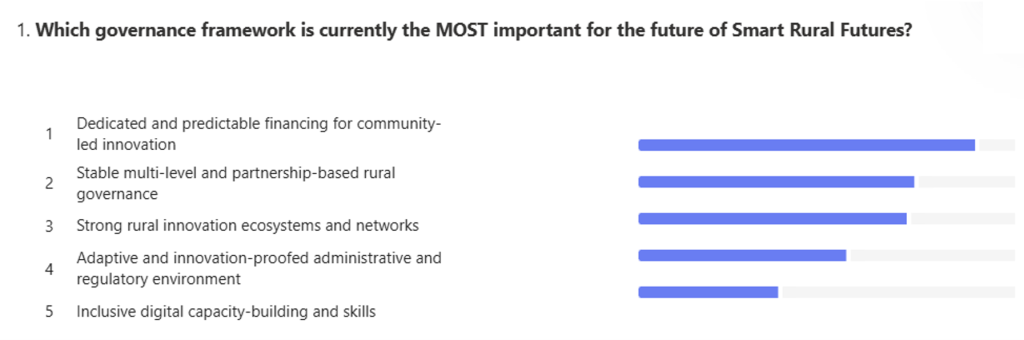
- She revisited the five governance frameworks discussed in Jonava, presenting them as complementary to address fragmented responsibilities, short-term funding, limited implementation capacity and weak coordination. Following her presentation, participants had the opportunity to test and further refine the frameworks, helping to identify any remaining gaps.
Representatives from the sister projects SMART ERA and RURACTIVE also contributed to the discussion. Matteo Gerosa and Benedetta Cavalieri highlighted shared challenges across European rural innovation projects, particularly the persistence of the “pilot trap”: promising solutions are tested successfully but struggle to continue or expand once project funding ends.
The discussion confirmed that scaling requires more than replication. Solutions must be adapted to each territory and supported by stable funding, intermediary organisations and appropriate governance structures.
Towards systemic uptake
The two EU-RIF events confirmed that successful rural innovation depends on more than developing good local solutions. It also requires governance systems able to recognise, finance, adapt and sustain those solutions over time.
Several common priorities emerged:
- Rural innovation should form part of long-term territorial strategies.Communities need ownership, skills and capacity.
- Intermediary organisations are essential for linking local actors with policymaking structures.
- Stable funding should be accompanied by appropriate governance and capacity-building support.
- Transfer should focus on adapting principles to local conditions rather than copying solutions directly.
The outcomes of the Jonava Forum and the policy webinar will feed into FUTURAL’s final policy recommendations. They will also inform the final EU-RIF meeting, planned for Austria in early 2027, where the project will further discuss its proposals for strengthening rural innovation across Europe.